
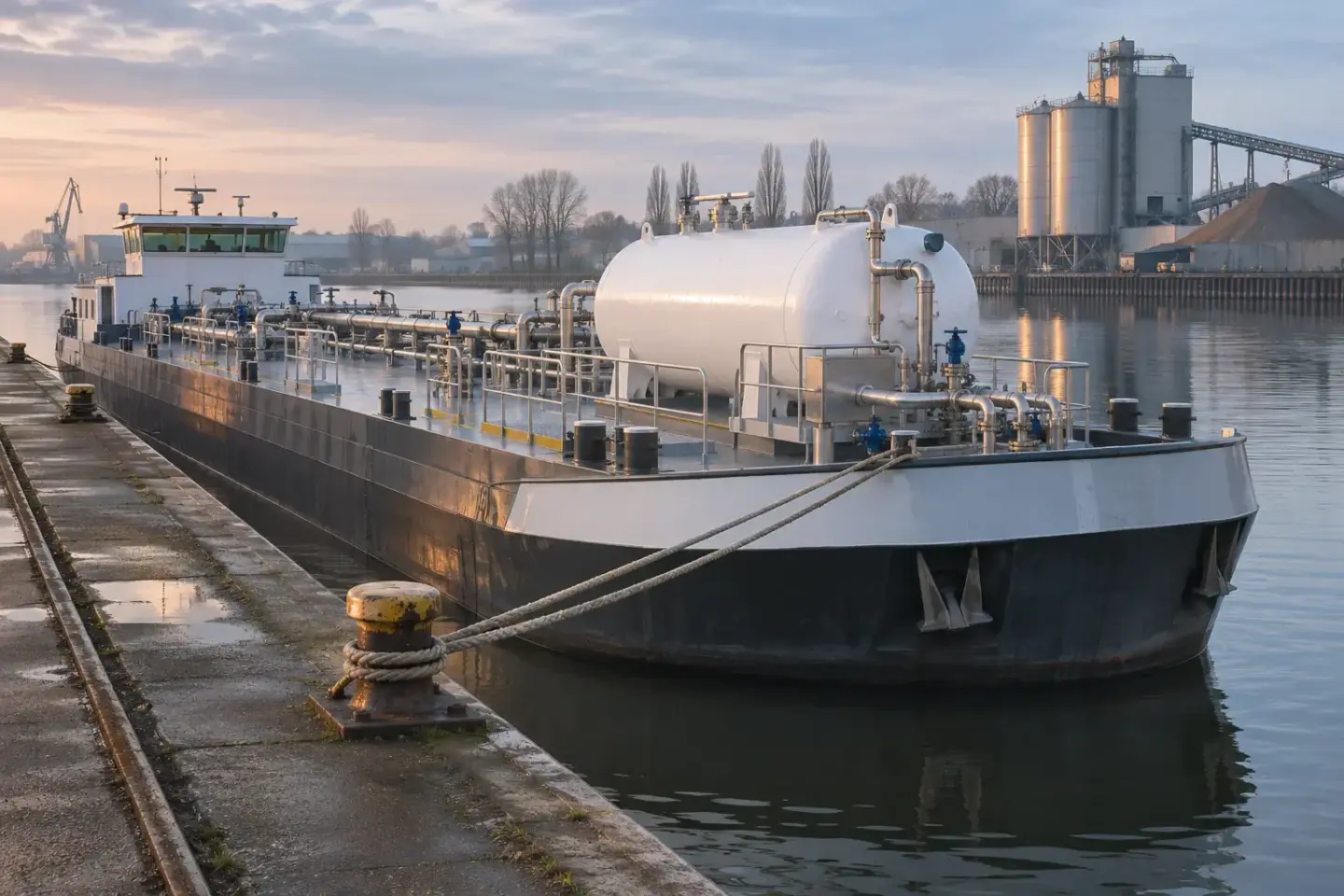
Liquefied natural gas has a real place in the history of European inland shipping. It also has a more complicated place in a low-emission fleet. An LNG installation tells you what fuel a vessel can use; it does not, on its own, tell you the vessel’s climate impact, the reliability of its supply chain or the economics of a particular voyage.
This guide separates those questions. It is an independent introduction, reviewed on 10 November 2026. The former Observatory hosted an LNG section at this address; the present publication is not that Observatory and does not operate its project database.
Start with the emissions boundary
Two comparisons are often confused. Air-pollutant performance concerns substances affecting air quality around vessels and ports. Climate performance concerns greenhouse gases across a specified boundary. A lower exhaust value for one pollutant cannot establish the second result.
The 2020 technical assessment hosted by CCNR identifies methane slip as a material issue for LNG. Methane escaping combustion can undermine a climate comparison based only on the carbon dioxide produced when fuel burns. That report is a dated technology assessment, not a current measurement of every LNG vessel. Read the 2020 assessment.
When assessing a claim, write its boundary beside its number: engine exhaust, onboard energy use, or production through final use. Then ask whether the comparator uses the same boundary and operating conditions. A figure without those details is a lead for further investigation, not a decision.
Compare complete operating patterns
A regular shuttle and an irregular long-distance service put different demands on a fuel system. Draw the actual sequence of loading, sailing, waiting, unloading and refuelling. Include the journeys with little or no cargo. A technically attractive system can be difficult to use if fuel delivery has to be arranged far from the commercial route.
For an initial project meeting, prepare five headings: usable onboard energy; space and weight taken by equipment; achievable refuelling arrangements; maintenance support; and the crew’s competence requirements. Keep supplier statements separate from independently demonstrated performance. In particular, a published bunkering location is not evidence of a confirmed delivery slot for your vessel.
| Question | Useful evidence | Common omission |
|---|---|---|
| What emissions improve? | Pollutants, greenhouse gases, boundary and operating profile | Calling every reduction “zero emission” |
| Can this route be supplied? | A dated supplier confirmation for compatible equipment | Treating a historical map pin as a booking |
| What does the installation displace? | Vessel-specific weight and space assessment | Comparing fuel prices while ignoring cargo capacity |
| Who can operate and maintain it? | Applicable qualification and service arrangements | Assuming diesel experience covers a new fuel |
Keep fossil LNG and other methane pathways distinct
“LNG” describes a liquefied gas fuel, while claims about renewable origin require their own evidence. A proposed switch to bio-LNG or synthetic methane therefore needs documented supply, sustainability accounting and compatible operation. The existence of a possible future pathway does not establish that today’s voyage used it.
The CCNR roadmap takes a fleet-level approach and explicitly rejects a single technology for every vessel family and sailing profile. Its public page includes a progress report adopted in 2025. That is a useful reason to compare LNG with other technically credible options for the same job, rather than with an imaginary vessel that has no operating constraints. CCNR roadmap and progress report.
Use early projects as evidence of learning
Early vessels help explain how fuel storage, bunkering, emergency planning and crew training became linked questions. They should not be turned into a fleet census. A launch announcement establishes an event at a date; it does not establish continuous operation, present ownership or today’s fuel mix.
Our dated project register keeps that distinction visible. For present navigation services and historical LNG references, use the information directory. Before a commercial decision, replace every historical assumption with current vessel, supplier and authority evidence. That final step is the difference between an interesting technology history and a usable transport proposal.